



Table of Contents
Introduction: The AI Frontier Just Got More Competitive
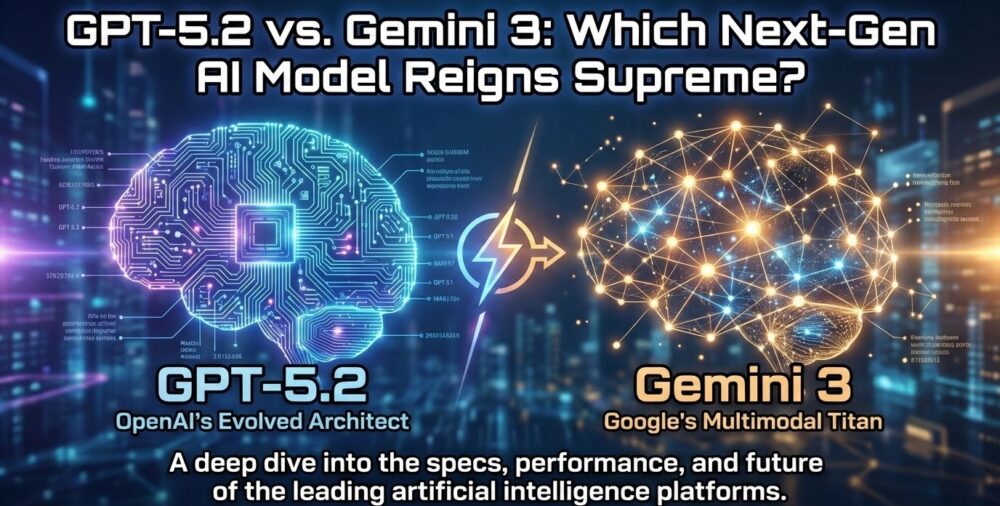
The landscape of artificial intelligence is evolving at an unprecedented pace. What was once the realm of science fiction is now a tangible reality, reshaping industries, empowering innovators, and redefining human-computer interaction. At the forefront of this revolution are Large Language Models (LLMs), sophisticated neural networks capable of understanding, generating, and even reasoning with human-like text, as well as increasingly other forms of data. As we stand on the cusp of the next generation of AI, two names loom large with immense anticipation: OpenAI’s GPT-5.2 and Google’s Gemini 3.
Both are poised to push the boundaries of what is possible, promising advancements that could fundamentally alter how we work, create, and interact with information. But as these titans of artificial intelligence prepare for their grand unveiling, a crucial question arises for developers, businesses, and AI enthusiasts alike: Which next-gen AI model will emerge as the leader, and more importantly, which one is best suited for your specific needs? This comprehensive exploration examines the anticipated capabilities, architectural philosophies, and strategic implications of GPT-5.2 and Gemini 3, providing valuable insights to navigate the exciting new era of AI innovation.
Understanding the Contenders: A Glimpse into GPT-5.2
OpenAI has consistently set benchmarks in the field of generative AI with its groundbreaking GPT series. From the early iterations to the widely adopted GPT-4, each release has brought significant leaps in language understanding and generation. GPT-5.2 is expected to continue this trajectory, building upon the formidable foundation laid by its predecessors.
The Evolution of OpenAI’s Flagship
The journey of the Generative Pre-trained Transformer (GPT) models has been one of continuous scale and refinement. Each new version has demonstrated enhanced capabilities in understanding context, generating coherent and creative text, and performing complex reasoning tasks. GPT-5.2 is not just an incremental update; it is anticipated to represent a substantial leap, potentially leveraging even larger datasets, more sophisticated training methodologies, and optimized architectures to achieve unprecedented levels of performance and versatility. OpenAI’s commitment to pushing the envelope in general-purpose AI is evident, and GPT-5.2 is a testament to that ongoing ambition.
Key Architectural Innovations and Capabilities
While specific details about GPT-5.2 are not yet public, industry trends and the progression of prior GPT models suggest several key areas of anticipated innovation:
- Enhanced Reasoning and Problem-Solving: Expect a significant improvement in its ability to tackle multi-step problems, logical deduction, and complex analytical tasks, moving beyond pattern matching to deeper semantic understanding.
- Superior Code Generation and Understanding: Drawing on the strengths seen in models like Codex, GPT-5.2 is likely to exhibit advanced capabilities in generating, debugging, and explaining code across various programming languages, making it an invaluable tool for software development.
- Advanced Multimodal Integration: While GPT-4 introduced nascent multimodal capabilities, GPT-5.2 is expected to feature more robust and seamlessly integrated understanding of images, audio, and potentially video alongside text, allowing for richer, context-aware interactions.
- Increased Context Window and Memory: A larger context window would enable the model to process and recall far more information within a single interaction, leading to more consistent, long-form content generation and complex conversational flows.
- Reduced Hallucinations and Improved Factual Accuracy: Continuous research in alignment and truthfulness is likely to result in a model that generates more reliable and factually grounded responses, a critical factor for enterprise adoption.
These advancements are set to make GPT-5.2 an even more powerful engine for knowledge work, creative endeavors, and complex computational tasks.
Use Cases and Target Industries for GPT-5.2
The potential applications for GPT-5.2 are vast and varied. It is particularly poised to revolutionize sectors requiring high-quality text generation, sophisticated code assistance, and advanced data interpretation:
- Content Creation and Marketing: Generating highly engaging blog posts, marketing copy, social media content, and personalized email campaigns with greater nuance and creativity.
- Software Development and Engineering: Assisting developers with code completion, bug fixing, generating boilerplate code, and even translating code between languages, significantly boosting productivity.
- Advanced Analytics and Research: Processing vast amounts of textual data to extract insights, summarize complex reports, and aid in scientific discovery by generating hypotheses or analyzing literature.
- Customer Service and Support: Powering more intelligent chatbots and virtual assistants capable of handling complex queries, offering personalized support, and resolving issues efficiently.
Gemini 3 Unveiled: Google’s Ambitious Answer
Google’s entry into the next-gen AI race with Gemini has been characterized by its ambitious multimodal vision and a commitment to foundational breakthroughs. Gemini 3 is anticipated to solidify Google’s position as a leader in comprehensive, real-world AI applications.
Google’s AI Vision and the Gemini Lineage
Google has a long-standing history of innovation in artificial intelligence, from its pioneering work in search algorithms to advancements in machine learning and neural networks. The Gemini project represents a culmination of this expertise, designed from the ground up as a native multimodal model, meaning it was trained simultaneously across different modalities from the start, rather than having them added on later. This foundational approach promises a more integrated and holistic understanding of diverse data types. Gemini 3 is expected to build upon the strengths of its predecessors, pushing the boundaries of what a single, unified AI model can achieve across various sensory inputs.
Architectural Prowess and Multimodal Integration
The defining characteristic of the Gemini series, and particularly Gemini 3, is its deep, native multimodal architecture. This isn’t just about processing different data types; it’s about understanding the relationships and nuances between them in a unified manner. Key architectural highlights and expected capabilities include:
- Truly Unified Multimodal Reasoning: Gemini 3 is expected to excel at tasks that require understanding and integrating information from multiple sources, including text, images, audio, and video, simultaneously. Imagine an AI that can not only describe an image but also understand the context from an accompanying audio clip and offer insights based on real-time video feeds.
- Enhanced Real-World Interaction: Its native multimodal design positions Gemini 3 for superior performance in robotics, augmented reality, and other applications requiring a deep understanding of the physical world and intuitive human-computer interfaces.
- Advanced Data Synthesis and Cross-Domain Understanding: The ability to synthesize insights from disparate data sources will be a core strength, enabling novel applications in scientific discovery, complex data analysis, and creative content generation that blends modalities.
- Efficiency and Scalability: Google’s expertise in large-scale infrastructure is likely to ensure Gemini 3 is highly efficient in terms of computational resources and scalable for demanding enterprise applications, a critical factor for widespread adoption.
- Safety and Responsible AI: Google has placed a strong emphasis on responsible AI development, and Gemini 3 is expected to incorporate advanced safety mechanisms and ethical considerations into its core design, aiming to mitigate biases and prevent harmful outputs.
Gemini 3’s architecture is designed to create AI that can understand and interact with the world in a more human-like, intuitive manner, opening the door to truly transformative applications.
Transformative Applications Across Sectors
Gemini 3’s native multimodal capabilities position it for unique and impactful applications:
- Robotics and Autonomous Systems: Enabling robots to better perceive, understand, and interact with complex environments, from manufacturing floors to exploration.
- Healthcare and Medical Imaging: Assisting with diagnosis by analyzing medical images (X-rays, MRIs) alongside patient records and research papers, offering more comprehensive insights.
- Creative Industries: Generating multimedia content, from creating animations based on text descriptions and music to designing immersive virtual experiences.
- Education and Training: Developing highly interactive and personalized learning experiences that adapt to different learning styles by integrating visual, auditory, and textual content.
- Advanced Data Analysis for Complex Systems: Analyzing sensor data, financial reports, market trends, and news articles concurrently to provide richer, more nuanced business intelligence.
Head-to-Head: A Feature-by-Feature Comparison
While both GPT-5.2 and Gemini 3 represent the zenith of current AI development, their distinct architectural philosophies and anticipated strengths create interesting points of comparison.
Performance Metrics and Benchmarking (Anticipated)
- Reasoning Ability: GPT-5.2 is likely to excel in complex logical reasoning tasks and symbolic manipulation, building on OpenAI’s strengths. Gemini 3, with its multimodal grounding, might show superior reasoning in real-world, context-rich scenarios involving diverse data types.
- Code Generation Efficiency: Given OpenAI’s lineage with Codex, GPT-5.2 is expected to maintain a leading edge in generating highly optimized and correct code. Gemini 3 will also have strong coding capabilities, potentially excelling in generating code for multimodal applications or embedded systems.
- Creative Output: Both models are expected to produce highly creative and coherent content. GPT-5.2 might shine in textual artistry, while Gemini 3 could open new frontiers in multimodal creativity, such as generating music to accompany a story or images to illustrate a poem.
- Factual Accuracy and Consistency: Both companies are heavily invested in reducing hallucinations. The model with superior integration of external knowledge bases and real-time information retrieval will likely gain an advantage in maintaining factual accuracy.
- Speed and Efficiency: With increased model sizes, optimization for speed and energy efficiency will be paramount. The winner here will depend on specific architectural optimizations and deployment strategies.
Multimodality: Native Integration vs. Enhanced Modules
This is perhaps the most significant differentiator. Gemini 3 is fundamentally designed as a native multimodal AI, implying a deeper, more integrated understanding across different data types from the outset. GPT-5.2, while expected to have robust multimodal enhancements, might still build on a primary text-centric architecture with modules for other modalities. This could mean Gemini 3 excels in tasks requiring true cross-modal understanding and synthesis, whereas GPT-5.2 might be exceptionally strong in enhancing text with visual or audio context.
Ethical AI and Safety Considerations
Both OpenAI and Google are at the forefront of discussing and implementing ethical AI practices. GPT-5.2 is expected to feature advanced alignment research, focusing on beneficial AI and robust safety protocols to prevent misuse and harmful outputs. Gemini 3 will likely embed Google’s comprehensive Responsible AI principles, including fairness, transparency, and accountability, directly into its core design. The effectiveness of these measures will be a critical factor in establishing public trust and promoting widespread adoption, especially in sensitive applications.
Accessibility and Ecosystem Integration
- OpenAI (GPT-5.2): Typically integrates well with Microsoft Azure’s cloud ecosystem, offering robust APIs and developer tools that cater to a broad range of applications. Its enterprise adoption is significant, and partnerships will likely expand.
- Google (Gemini 3): Will be deeply integrated into the Google Cloud Platform, leveraging Google’s vast array of AI services, data solutions, and global infrastructure. This offers seamless deployment for enterprises already within the Google ecosystem, as well as unique opportunities for Android and hardware integration.
The Strategic Implications for Businesses and Developers
Navigating the capabilities of these next-generation AI models requires a clear strategic approach. The choice between GPT-5.2 and Gemini 3 will largely depend on specific project requirements, existing infrastructure, and long-term AI vision.
Choosing the Right AI: Tailoring to Your Needs
- When GPT-5.2 Might Be Preferred: Businesses and developers primarily focused on advanced text generation, complex code assistance, sophisticated natural language processing, or creative writing tasks will find GPT-5.2’s refined capabilities highly advantageous. Its potential for deep textual reasoning and structured output could be unmatched for applications like legal document analysis, academic research tools, or high-volume content automation.
- When Gemini 3 Might Be Preferred: For projects requiring a truly integrated understanding of the physical world, complex multimodal data analysis, or applications in robotics, autonomous systems, and interactive AR/VR, Gemini 3’s native multimodal architecture will likely offer a distinct advantage. Its ability to process and synthesize information across text, vision, and audio natively could unlock entirely new categories of AI-powered solutions.
Future-Proofing Your AI Strategy
Regardless of the initial choice, businesses must cultivate an AI strategy that is adaptable and forward-looking. The rapid pace of innovation means that today’s leading model might be surpassed tomorrow. Focus on:
- Modular Architectures: Design your systems to be model-agnostic where possible, allowing for easier swapping or integration of new AI models as they emerge.
- Continuous Learning and Experimentation: Invest in ongoing research and development to understand the evolving capabilities of these models and identify new use cases.
- Talent Development: Equip your teams with the skills to work with advanced AI models, understanding their strengths, limitations, and ethical implications.
The Competitive Landscape and Innovation Drive
The rivalry between OpenAI and Google in this space is a powerful catalyst for innovation. This competition drives both entities to continually refine their models, enhance performance, and expand their capabilities. Ultimately, this intense drive benefits the entire AI ecosystem, leading to more powerful, versatile, and accessible AI tools for everyone.
Beyond the Hype: Practical Considerations for Adoption
While the technological marvels of GPT-5.2 and Gemini 3 are exciting, practical considerations are crucial for successful enterprise adoption.
Cost-Benefit Analysis and Resource Allocation
Implementing cutting-edge AI models entails significant costs associated with API usage, computational resources, and specialized talent. A thorough cost-benefit analysis is essential, weighing the potential returns on investment against the operational expenses. Enterprises should also consider their existing infrastructure and how seamlessly these new models can be integrated.
Data Privacy and Security Implications
Working with advanced AI often involves feeding proprietary or sensitive data to the models. Robust data privacy frameworks, compliance with regulations like GDPR and CCPA, and secure data handling protocols are non-negotiable. Understanding how each provider addresses data security and privacy will be crucial for establishing trust and ensuring legal compliance.
Skill Development and Workforce Readiness
The introduction of more sophisticated AI tools necessitates a skilled workforce capable of leveraging them effectively. Organizations must invest in training programs to upskill their employees, fostering a culture of AI literacy and responsible AI usage. This includes not only technical skills but also critical thinking and ethical reasoning in an AI-augmented environment.
Conclusion: A New Era of AI Innovation
As we eagerly await the full unveiling of GPT-5.2 and Gemini 3, one thing is clear: we are entering an exhilarating new era of artificial intelligence. Both models represent monumental achievements in machine learning, each offering a distinct path to advanced AI capabilities. GPT-5.2 is anticipated to push the boundaries of language understanding and code generation, solidifying its position as a powerhouse for text-centric and developer-focused applications. Gemini 3, with its native multimodal architecture, promises to unlock unprecedented understanding and interaction across diverse data types, paving the way for truly intelligent real-world systems.
The question of which model “reigns supreme” ultimately depends on the specific challenges you aim to solve. For some, the linguistic finesse and coding prowess of GPT-5.2 will be indispensable. For others, the integrated multimodal intelligence of Gemini 3 will open doors to previously unimaginable applications. The true winner, however, is the global community of developers, researchers, and businesses who will benefit from this intense competition and the accelerated pace of innovation it brings. Embrace this new frontier, experiment with these powerful tools, and prepare to redefine what’s possible with artificial intelligence. The future of AI is not just about choosing a model; it’s about creatively leveraging its strengths to build a more intelligent, efficient, and interconnected world.
Leave A Reply